Review 1: Help getting organized
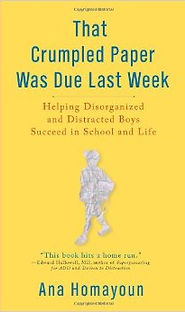
This book looks at practices of both parents and teen boys, and what can be done to help boys find what they need to achieve. While some of the book ventures into neuro-science (as in, how boys in their teenage years process things differently from girls), the book is easy to read. It is also based on some solid developmental learnings that have been around for years. Indeed, since the author's techniques for working with teens is based on a similar psychological foundation as my own, many of her practices sound familiar. They are the kinds of practices that are at work in your student's English classroom.
Here is a brief introduction to the book, in case you were thinking of looking for some more help with your student.
______________________
All too often we inadvertently focus on external rewards (getting an A on a test, making the honor roll, getting into a certain college) rather than looking at the internal factors that motivate each of us to feel that the possibilities are limitless. When your son is excited about something— anything— his whole countenance will change— and his outlook on life will improve. By asking your son what he is interested in accomplishing, you are inviting him to visualize the success that he may not be finding right now in his life. You are encouraging him to look beyond the narrow, short- term goals of turning in homework and acing quizzes, and allowing him to explore the bigger picture of his dreams and inspirations. You’re also helping him reframe his own way of thinking to see organization and study skills as stepping- stones or the means to an end, rather than an overwhelming burden.
In my experience, positive parental approaches and attitudes are key elements to helping children become better organized, independent, and self- reliant young people. I meet a lot of parents who feel personally embarrassed and guilty about their son’s poor academic performance, detachment from school, and general malaise. Yet by complaining about their son’s shortcomings, they are actually (unwittingly) creating a more toxic environment.
Far too often, we adults tend to overlook those things that make a young person feel happy and fulfilled; instead, we focus solely on problems— what’s not going well in school in relation to homework, tests, and GPAs. Often students are surprised that I’m so interested in what they love to do— they thought they were just coming in to learn how to get organized— and they can get quite excited talking about their rock band or love of rowing or how much they really enjoy reading historical fiction. Far too often, we adults tend to overlook those things that make a young person feel happy and fulfilled; instead, we focus solely on problems— what’s not going well in school in relation to homework, tests, and GPAs. Once I’ve learned about their individual interests, I explain how they can more efficiently get their homework and studying done by adopting organizational and time- management skills so that they have more time to pursue those very passions. Then, before they leave, I have them come up with three academic and three personal goals that they want to accomplish within the next semester or school year. In coming up with these goals, students are taking two very important steps: They’re establishing a clear purpose and path for accomplishing what they want to accomplish, and they’re beginning to view being organized as an important part of finding their own personal pathway.
The reason this works is that by simply focusing on their strengths instead of railing against what they are doing wrong, we set a foundation and build from there. It’s demoralizing and ineffective to focus on the negative— who ever enjoyed that meeting with a boss who only told you everything you did wrong? One of the main reasons my system works so well for boys is that they quickly find it to be the classic win- win situation. The truth is that when you help boys figure out what they truly desire and aspire to accomplish in their lives, (discussed in Chapter 4), you are finally giving them a real reason to become better organized and take control of their lives. Just getting good grades or being admitted to the right college are not enticing enough goals for most young people to embrace long- term changes to becoming a more invested, engaged, and active person. When you give boys the tools they need to organize their lives, not only do their grades improve but the overall quality of their lives also improves.
______________________
Overall a better quality of life, not to mention better grades? Those sound like good goals. At least to me -- and this book offers you some tools to help your student achieve these goals. Just a thought.
Dr. Schellenberg